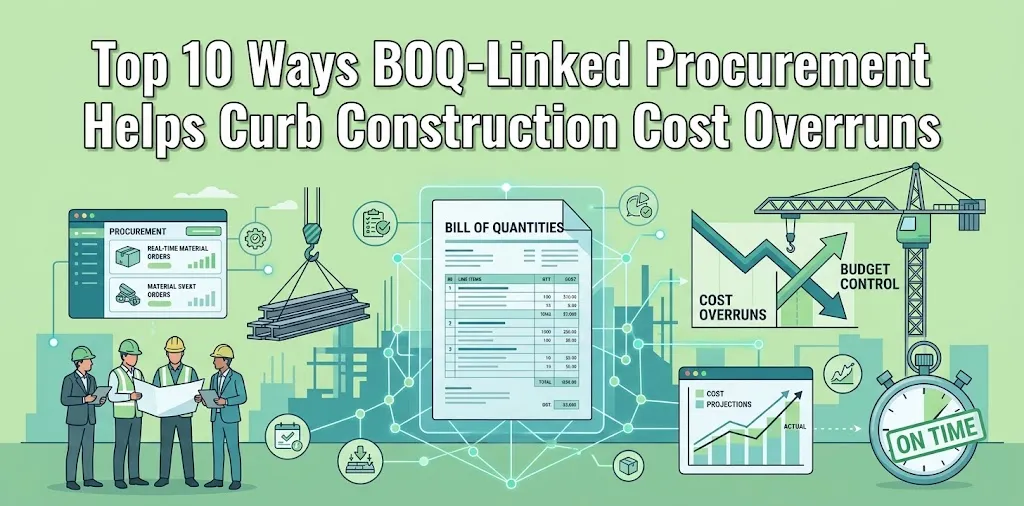
Top 10 Ways BOQ-Linked Procurement Helps Curb Construction Cost Overruns

Ask a builder where their budget actually leaks, and procurement usually comes up before anything else. Not because materials are inherently expensive, but because purchases often happen disconnected from the Bill of Quantities (BOQ) that was supposed to govern them in the first place. Someone orders more cement than the phase needs. A supplier quote changes and nobody notices until the invoice arrives. Small gaps like this quietly add up into a cost overrun nobody planned for.
BOQ-linked procurement is meant to close that gap by tying every purchase directly back to what the project actually requires. Here’s how it does that, in ten concrete ways.
1. Purchases Are Validated Against the BOQ
Before an order is approved, the system checks it against the quantities and specifications already defined in the BOQ. If someone tries to requisition far more steel than the phase calls for, that mismatch gets flagged before money leaves the account, not after.
2. Real-Time Budget Consumption Tracking
Every approved purchase reduces the remaining BOQ budget for that item, visible instantly. Builders don’t have to wait for a monthly reconciliation to find out a line item is running over — they see it happening in real time.
3. Prevents Over-Ordering and Material Wastage
Over-ordering doesn’t just cost money upfront; it ties up storage, invites pilferage, and often results in materials that degrade before they’re used. Linking procurement to the BOQ keeps quantities aligned with actual project needs, phase by phase.
4. Vendor Comparison and Quotation Management
Good systems let you log multiple vendor quotes against the same BOQ item and compare them side by side. This turns procurement decisions into something documented and defensible, rather than a phone call that nobody wrote down.
5. Purchase Order Approval Workflows
A structured approval chain — site engineer requests, project manager reviews, finance approves — prevents purchases from happening on informal instructions. It also creates a clear record of who approved what, and why, which matters when costs are questioned later.
6. Rate Variance Alerts
When a vendor’s quoted rate differs meaningfully from the BOQ’s estimated rate, the system should flag it immediately. This is often the earliest sign of either market price shifts or a vendor quietly padding numbers, and it’s much easier to deal with early than after a dozen invoices.
7. Phase-Wise Material Release Control
Materials don’t need to be released to a site all at once. Tying releases to the current construction phase prevents a stockpile of finishing materials showing up before the structural work is even done — which is as much a cost issue as a storage one.
8. Consolidated Reporting Across Projects
For builders running several sites, BOQ-linked procurement makes it possible to compare cost performance across projects — which one is running efficiently, and which one needs a closer look — using the same standardized data structure.
9. Reduces Manual Reconciliation Errors
When procurement, inventory, and BOQ data live in separate spreadsheets, reconciling them is slow and error-prone. Linking them directly removes most of the manual matching that usually introduces mistakes in the first place.
10. Clear Audit Trail for Every Purchase
Every purchase order, approval, and payment tied to a BOQ item creates a traceable history. If an investor or landowner ever asks why a particular cost came in higher than planned, the answer is already documented instead of being reconstructed from memory.
Why This Matters More in Bangladesh
Material prices here can shift quickly, and construction timelines often stretch longer than originally planned due to approvals, weather, or financing delays. That combination makes BOQ discipline even more important — a small unchecked variance early in a project can compound into a serious overrun by the time the building is handed over.
This is exactly the kind of control Pintech ERP builds into its procurement process. As part of its real estate ERP software, purchases are validated against the BOQ automatically, with budget consumption, vendor comparisons, and approvals all handled in one connected system — so a builder isn’t discovering a cost overrun after the concrete has already been poured.
Final Thought
Cost overruns rarely happen because of one big mistake. They happen through dozens of small, disconnected purchases that nobody was checking against the actual plan. BOQ-linked procurement doesn’t eliminate every risk in construction, but it does close the gap between what a project was supposed to cost and what it’s actually spending — which, for most builders, is exactly where the real savings are hiding.